
Faculty Fanfare: Chi Wang

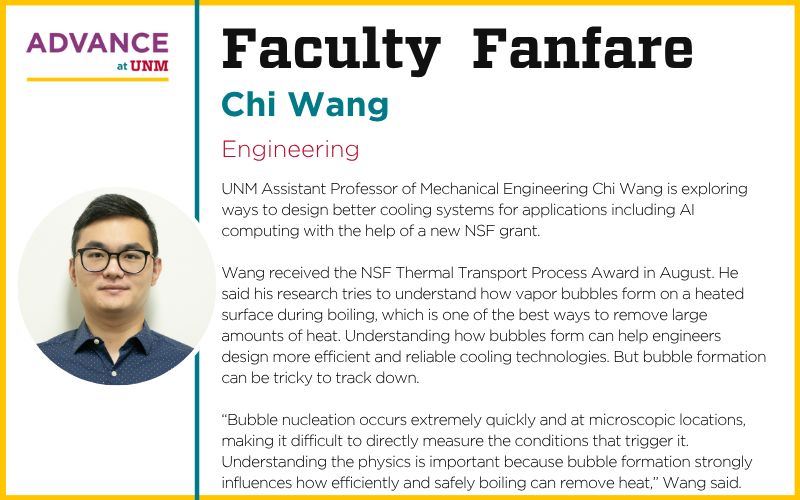
Engineering professor hopes understanding bubble formation will help keep data centers cool
UNM Assistant Professor of Mechanical Engineering Chi Wang is exploring ways to design better cooling systems for applications including AI computing with the help of a new NSF grant.
Wang received the NSF Thermal Transport Process Award in August, He said his research tries to understand how vapor bubbles form on a heated surface during boiling, which is one of the best ways to remove large amounts of heat.
Understanding how bubbles form can help engineers design more efficient and reliable cooling technologies. But bubble formation can be tricky to track down.
“Bubble nucleation occurs extremely quickly and at microscopic locations, making it difficult to directly measure the conditions that trigger it. Understanding the physics is important because bubble formation strongly influences how efficiently and safely boiling can remove heat,” Wang said.
Knowing more about the process could lead to improved surfaces and cooling systems for a variety of high-power technology.
“A relatable example is AI and data centers, where increasingly powerful computer chips generate enormous amounts of heat and cooling has become a major challenge. The same physics is also important for nuclear reactors, electric vehicles, power electronics, and aerospace systems” Wang said.
“By better understanding and controlling bubble formation, we can ultimately improve how these technologies manage heat, making them more efficient, compact, and reliable.”
To measure the formation of bubbles, Wang and his team are developing an advanced nanothermometry technique that uses tiny light-emitting nanoparticles as temperature sensors.
“These nanoparticles are placed at engineered nucleation sites, and their light emission changes with temperature, allowing us to measure extremely fast and localized temperature changes that conventional sensors cannot capture. This gives us a way to observe the thermal conditions at the moment a vapor bubble begins to form and helps uncover the physics behind bubble nucleation,” he said.
Wang said the work is important now as technologies become more powerful and generate more heat than previous tech.
“AI computing and data centers, electric vehicles, advanced nuclear energy, and aerospace systems all require better ways to manage extremely high heat loads,” he said. “Boiling has tremendous potential for these applications, but our ability to design reliable boiling-based cooling systems is still limited by gaps in our fundamental understanding of how bubbles form. By uncovering this physics, we can help enable the next generation of more efficient and reliable thermal management technologies.”
The grant is for three years and provides $450,000 in funding.