
Faculty Fanfare: Lisa Marchiondo

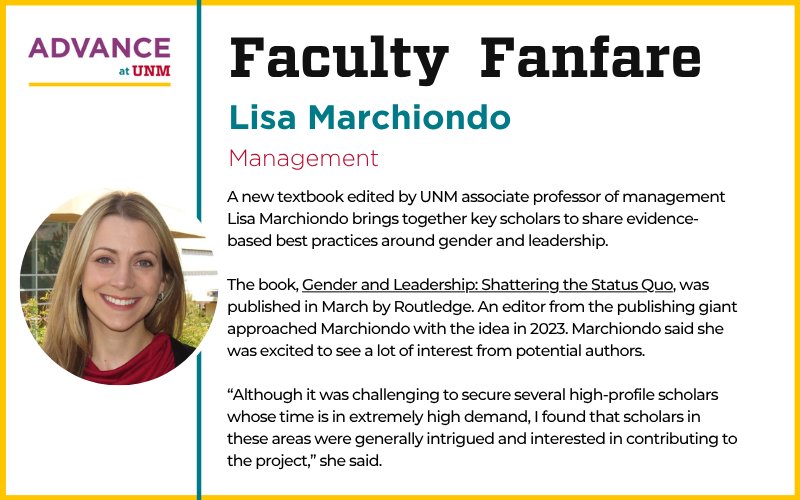
New textbook by management professor shines light on structures that present challenges for women leaders
A new textbook edited by UNM associate professor of management Lisa Marchiondo brings together key scholars to share evidence-based best practices around gender and leadership.
The book, Gender and Leadership: Shattering the Status Quo, was published in March by Routledge.
An editor from the publishing giant approached Marchiondo with the idea in 2023. Marchiondo said she was excited to see a lot of interest from potential authors.
“Although it was challenging to secure several high-profile scholars whose time is in extremely high demand, I found that scholars in these areas were generally intrigued and interested in contributing to the project,” she said.
She was less excited, however, to figure out how to narrow all of the available information down to meet the book’s length requirements.
“There is such a wide variety and exciting breadth of topics within the realm of gender and leadership,” said Marchiondo, the associate director of ADVANCE at UNM whose expertise is in gender, aging, and organizational behavior.
While the book is primarily meant for students, Marchiondo said it is written in an engaging style with real-world examples that present current information to practitioners and organizational leaders as well.
“Leadership is a complex, multi-faceted concept. More work is needed to disseminate the rigorous, evolving research in this domain to students, practitioners, and organizational leaders.”
Right now, “too many leadership-related decisions are made without knowledge of what really works — and what can actually help level the playing field across gender…through this book, this group of scholars strives to disseminate these evidence-based best practices.”
Among other things, the book focuses on the unique challenges women face in their leadership journeys.
“Many chapters highlight the structural and cultural forces that make these journeys more challenging for women than men, ultimately highlighting the need for higher-order changes, as opposed to more programs focused on telling women what they need to do differently to succeed,” she said.
One chapter, “When and Why Should We Care about Gender in Negotiation?” discusses how individuals and organizations can mitigate potential gender/sex biases in common types of negotiations through a framework for negotiation preparation called “Be SURE.” The framework is described by the chapter’s authors, Hannah Riley Bowles and Shan Sherwan Hussein, both of Harvard. It outlines situations in which gender/sex affects career-related negotiations, including compensation, role advancement, and work–family conflict.
Marchiondo highlighted other chapters including one written by Jennifer Berdahl, a professor at the University of British Columbia, titled, “Masculinity Contest Cultures: Academia as an Exemplar.” She also called attention to the chapter “Moving Forward: What Works — and What Doesn’t — to Advance Women at Work,” by Siri Chilazi, senior researcher at the Harvard Kennedy School.
As part of the book, Marchiondo also co-wrote a chapter related to case studies that highlight complex workplace scenarios, with Nicole Capehart, a lecturer at the James and Gail Ellis School of Business Leadership.