
Faculty Fanfare: Elspeth Iralu

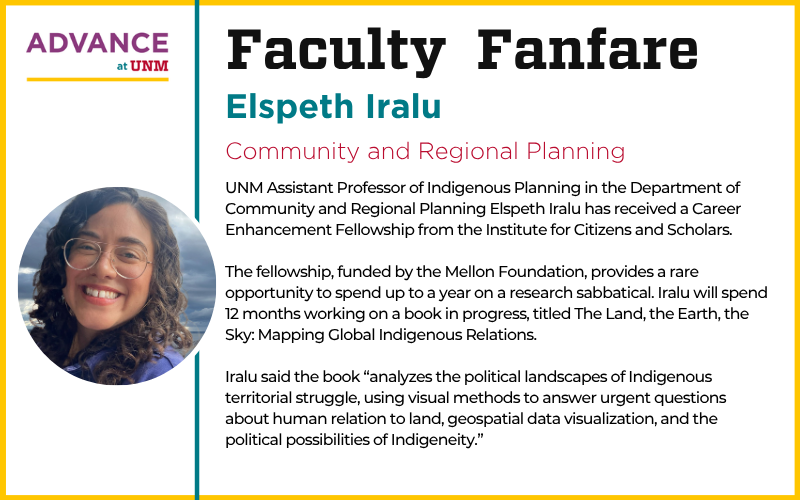
Indigenous planning professor receives fellowship for book research sabbatical
UNM Assistant Professor of Indigenous Planning in the Department of Community and Regional Planning Elspeth Iralu has received a Career Enhancement Fellowship from the Institute for Citizens and Scholars.
The fellowship, funded by the Mellon Foundation, provides a rare opportunity to spend up to a year on a research sabbatical. Iralu will spend 12 months working on a book in progress, titled The Land, the Earth, the Sky: Mapping Global Indigenous Relations.
Iralu said the book “analyzes the political landscapes of Indigenous territorial struggle, using visual methods to answer urgent questions about human relation to land, geospatial data visualization, and the political possibilities of Indigeneity.”
Already, Iralu has rough drafts of most of the book chapters. During the fellowship, she will refine them and add new research, she said.
The book will include analyses of historical maps, mapping software, graphic novels, virtual reality, and visual art and consider how these visualizations articulate the spatial extent of Indigenous sovereignty. Iralu also is exploring what these tools say about how knowledge is produced about Indigenous space and place.
“This book considers why and how the aerial perspective has been normalized as an intimate way of seeing Indigenous territory,” she said. “This starting place grounds longer histories and ongoing struggles over Indigenous territories to analyze how the aerial perspective structures contemporary colonial relations to Indigenous land.”
The book ties into Iralu’s larger work on how Indigenous peoples represent relations to land, space, and place, with their own terms, methods and purposes.
She said the work is particularly important at this time because it gets at how we relate to others who are geographically distant.
“In our current moment, these are essential questions that expand well beyond the purview of my scholarly world of Indigenous geographies, yet the intellectual, political, and technical contributions and considerations of this field makes it uniquely positioned to address these questions head on,” Iralu said.
“This book will be attentive to the current political moment while understanding it within a longer historical context of Indigenous geographic knowledge production.”