
Faculty Fanfare: Heng Zuo

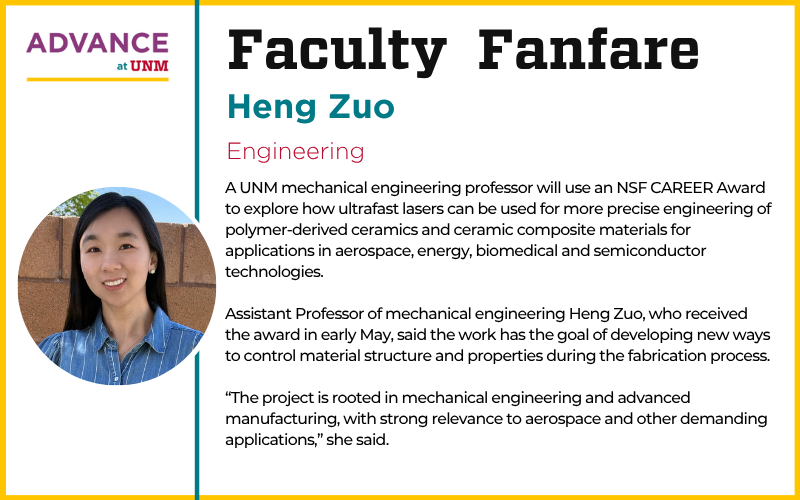
Engineering professor aims to improve high-tech manufacturing with NSF CAREER Award
A UNM mechanical engineering professor will use an NSF CAREER Award to explore how ultrafast lasers can be used for more precise engineering of polymer-derived ceramics and ceramic composite materials for applications in aerospace, energy, biomedical and semiconductor technologies.
Assistant Professor of mechanical engineering Heng Zuo, who received the award in early May, said the work has the goal of developing new ways to control material structure and properties during the fabrication process.
“The project is rooted in mechanical engineering and advanced manufacturing, with strong relevance to aerospace and other demanding applications,” she said.
For example, the project will explore how ultrafast laser pulses can make highly localized changes in ceramic precursor materials, allowing researchers to better control how the final ceramic structure forms. That level of control could eventually help engineers design ceramic components whose properties are tailored to different regions of the same part.
Zuo said she felt fortunate to receive the competitive award on the first try.
“My first reaction was excitement, relief, and gratitude. A lot of work goes into a CAREER proposal, so it was incredibly rewarding to see it come through,” she said.
“For an early-career faculty member, the CAREER Award is a major milestone, so receiving it felt both validating and motivating.”
The five-year award will provide sustained support for the experimental and modeling work central to Zuo’s research program, along with the materials and facility access needed to carry it out. It will also create opportunities for student training, curriculum development, and outreach activities tied to the project.
More broadly, Zuo said, it helps establish a long-term research direction in ultrafast laser manufacturing and advanced ceramic materials at UNM.
Zuo’s broader research brings together advanced manufacturing, optics, mechanics, materials, and computational modeling, with applications ranging from laser-based processing of advanced materials to space optical engineering systems and fabrication technologies for thin- shell, high-resolution X-ray telescope mirrors.
Zuo said the CAREER Award is especially meaningful because it supports researchers beyond a single project.
“It encourages you to think carefully about the long-term trajectory of your research and how it connects to students and education,” she said.