
Faculty Fanfare: Laura Kohl, Sever Bordeianu and Isabella Pilar Brouse

UNM librarians and faculty publish article outlining promise of ChatGPT to reduce cataloging backlog
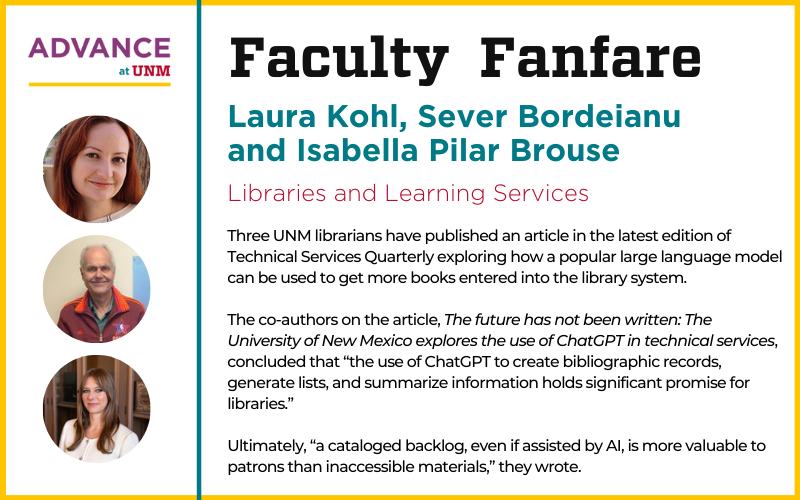
Three UNM librarians have published an article in the latest edition of Technical Services Quarterly exploring how a popular large language model can be used to get more books entered into the library system.
The co-authors on the article, The future has not been written: The University of New Mexico explores the use of ChatGPT in technical services, are Laura Kohl, associate professor and principal cataloger, Sever Bordeianu, professor and director, and Isabella Pilar Brouse, library information specialist III. The trio work in the Technical Services at UNM’s College of University Libraries and Learning Services.
While interest and use of artificial intelligence has grown dramatically in recent years, Kohl said all interested Libraries employees have had subscriptions to ChatGPT since 2023. That move was thanks to former Libraries Dean Leo Lo, who asked staff to think strategically about incorporating AI into their workflows, she said.
At first, Kohl said she was hesitant.
“However, as I began experimenting with it, I became more open to its potential and recognized how useful it could be,” she said. “Cataloging backlogs seemed like a natural starting point for experimentation. These materials are generally older and lower priority, unlike new purchases that are processed quickly to ensure timely patron access.”
Librarians experimented with prompts for more than a year that aimed to automate parts of the cataloging process using ChatGPT.
The work led Kohl, Bordeianu and Brouse to write about their experience.
The article explores prompts, or sets of instructions, that librarians gave ChatGPT related to processing library materials. These included asking AI to analyze images such as book covers as well as text inputs to create cataloging records.
As part of the research, the librarians explored successful prompts that lead ChatGPT to extract accurate cataloging information on its own, as well as examples where human intervention was needed.
One challenge was not knowing what sources Chat was pulling information from.
“By definition, GPT can only mimic a bibliographic record, but cannot generate a genuine, validated one. For this reason, human review, and ultimately expert review, is essential for ensuring the quality of the record,” the authors wrote.
Through their research, the authors concluded that “the use of ChatGPT to create bibliographic records, generate lists, and summarize information holds significant promise for libraries.”
Ultimately, “a cataloged backlog, even if assisted by AI, is more valuable to patrons than inaccessible materials,” they wrote.
The article also advocates for librarians to take an active role in using AI, something Kohl said UNM Libraries is already doing, although perhaps not to the extent other institutions might be.
“I don’t believe there is any realistic scenario in which AI will not be part of our future. It seems more productive to engage with it thoughtfully now and make intentional decisions about how we use it,” she said. “AI is already being integrated into our core systems – the library catalog – by library service providers. It is increasingly embedded into the tools we use every day and will become more prominent in the years ahead.”
Like many parts of the discussions around AI right now, research is opening up new questions about how to best use, work, learn and teach with such rapidly evolving tools.
“Beyond technical services, AI is also being used in reference contexts and holds significant potential for integration into reference and teaching, where it may support research assistance, literacy instruction, and student engagement,” Kohl said.
At the same time, guardrails and critically thinking humans must remain in place, especially for libraries given their valued status in society as a reliable source of accurate information.
“Like any technology, AI is best understood as a tool and not as an assistant to which we surrender all control. With supervision and guidance, it can be remarkably useful and can increase productivity, but it requires substantial oversight,” she said.
And the clamor over AI must be tempered with caution, Kohl said.
“The prospect of using any technology to make our daily work easier is very tantalizing. This is an exciting time in libraries, as there are many meaningful ways AI can assist us, particularly in digitizing, describing, and promoting our collections. At the same time, that excitement must be balanced with practical realities.”
UNM Libraries also is uniquely positioned to use AI’s multilingual capabilities given its large collection of non-English materials, Kohl said.
“In the past, libraries often sought to hire staff fluent in specific languages to support cataloging and access. As the workforce and hiring landscape has evolved, that is not always possible. AI-assisted translation tools have made working across languages significantly easier and more accessible.”
That’s an exciting advancement because “improved translations produce higher quality metadata for non-English materials, enhancing discovery and access. When description improves, research improves,” she said.
Kohl also said the use of AI raises complex questions and opinions all around.
“Not every perspective on AI was expressed in our article; there is much more to be said. Like many others, I’m concerned about the environmental impact. At the same time, I consider myself a pragmatist,” she said. “I believe there is value in exploring AI thoughtfully, while being mindful of its broader consequences. I also hope that librarians and students entering the profession will continue to learn foundational principles of our discipline rather than turning immediately to technology for answers.”