
Faculty Fanfare: Lauren McQuistion

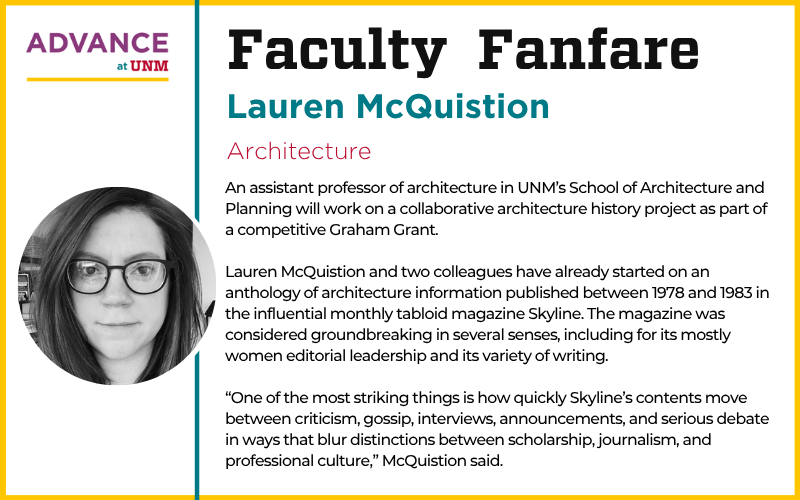
Architecture professor awarded grant for research on pivotal architecture history magazine
An assistant professor of architecture in UNM’s School of Architecture and Planning will work on a collaborative architecture history project as part of a competitive Graham Grant.
Lauren McQuistion and two colleagues have already started on an anthology of architecture information published between 1978 and 1983 in the influential monthly tabloid magazine Skyline. The magazine was considered groundbreaking in several senses, including for its mostly women editorial leadership and its variety of writing.
“One of the most striking things is how quickly Skyline’s contents move between criticism, gossip, interviews, announcements, and serious debate in ways that blur distinctions between scholarship, journalism, and professional culture,” McQuistion said.
“The historical moment that it captures really shows architecture as an active social and intellectual network that feels very interdisciplinary rather than simply documenting finished buildings. A recurring surprise has been how contemporary many of the conversations feel.”
McQuisition is working with colleagues Alex Maymind of the University of Minnesota and David Turturo of Texas Tech. The trio will conduct in person interviews and oral histories in New York later this summer.
“This project developed out of conversations that began through connections made at conferences and shared interests in architectural history and media,” McQuistion said.
“Because our collaboration formed across three institutions, receiving support from the Graham Foundation felt especially meaningful as recognition that this kind of collaborative, archival, and humanities-based research matters. We’re also excited to have dedicated time and resources to develop a project that otherwise would be difficult to pursue at this scale.”
The project involves interviewing a broad range of writers and editors who worked on the magazine “whose work shaped the publication from editorial, institutional, and informal positions and hearing how they understood Skyline’s role at the time.”
McQuistion said Skyline cataloged the evolution of architecture projects and not just the finished pieces.
“Skyline occupies an unusual position in architectural history because it documented architectural culture while it was unfolding. Rather than presenting polished historical narratives, it captured conversations, disagreements, institutional politics, and emerging ideas in real time,” she said.
Additionally, the magazine’s leaders offered an important counterpoint to dominant histories of architectural discourse from the 1970s and 80s that typically centered individual critics or “starchitects,” McQuistion said.
Examining the old issues of Skyline has offered the opportunity to explore how intellectual communities get started and how ideas circulate within them.
“At a moment when media ecosystems across fields, including architecture, are changing rapidly, Skyline offers a historical example of how publishing shaped professional discourse outside of more typical formats like glossy trade magazines or scholarly journals,” she said. “Revisiting Skyline and the media culture it was a part of helps us better understand how architectural knowledge is produced and who gets to participate in those conversations.”
Their work will culminate in the development of an anthology that will offer selected reprints, archival materials, oral histories, and contemporary essays. McQuistion said the goal of the project is to provide historical context and make these conversations accessible to new audiences.
McQuistion said it’s been rewarding to see the project – which was awarded in one of the Graham Foundation’s most competitive funding cycles in recent years – rise up from conversation and collaboration.
“The process of connecting with and building rewarding working relationships with colleagues at other universities reflects how conference communities, shared interests, and cross-institutional partnerships can develop into meaningful research projects,” she said.
“It also reminds us that archives are not only repositories of the past but active tools for asking new questions in the present.”