
Katherine Pearce, Mathematics and Statistics

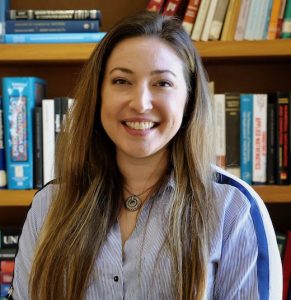
Name:
Katherine Pearce
Title:
Assistant Professor
Department:
Mathematics and Statistics
Describe your research in about 200 words.
I develop and analyze randomized algorithms in numerical linear algebra to solve problems that frequently arise in data science, engineering, and many other scientific disciplines. Numerical linear algebra is a branch of mathematics focused on computational methods to work with arrays of numbers, such as matrices or tensors, in a reliably accurate way. Matrices and tensors can be used to represent data from a variety of sources, such as medical imaging, scientific experiments, large-language models (LLMs), and many more. However, many classical algorithms in numerical linear algebra are too slow or require too much computer memory. My research uses randomness as a mathematical tool to build faster algorithms that still yield provably accurate results. Instead of looking at the entirety of the data, these randomized algorithms compress the data into a smaller size that retains the same information, making large-scale computations significantly faster and more memory-efficient. I am particularly interested in faster scientific computing applications, such as machine learning, signal processing, scientific simulations (e.g., fluid flow or climate modeling), computational biology and chemistry, and other data-intensive fields. UNM already has exceptional people working in these areas, and I am very excited to learn more about their research and share ideas.
What’s the most interesting thing you have learned from a student?
One of my incarcerated students told me that she finds math really comforting, even though she hated it growing up. She said she used to dislike how math problems only have one right answer, but as she got older, she realized that so many problems we are faced with in our daily lives don’t have clear-cut solutions. It really changed how I thought about math and made me grateful, even in times of frustration, for the opportunity to find right answers in math classrooms everyday.