2024 Awards
14 UNM faculty members chosen for the 2024 Women in STEM Awards

The 11 funded projects include a study of carbon storage in soils along the middle Rio Grande floodplain, an investigation into rural New Mexico healthcare workforce challenges and opportunities, and the development of new software for large scale 3-D printing with adobe
Fourteen faculty members at the University of New Mexico have been selected for the 2024 Women in STEM Awards.
Selected award recipients will consider water treatment processes for atmospheric water harvesting, look for ways to improve local food system cohesion, and study the role of social interaction in stress and depression, among other things.
Now in their ninth year, the awards have allocated $585,660 to 80 women at UNM.
Several of the 11 projects selected this year are collaborative or interdisciplinary efforts.
-
The 2024 winners are:
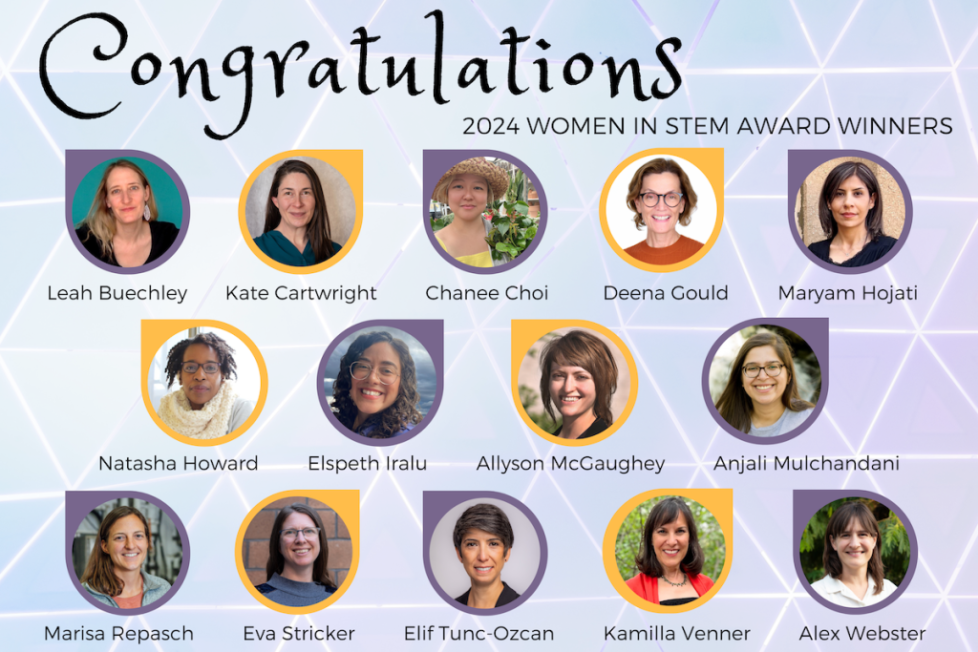
Leah Buechley, an associate professor in Computer Science and Maryam Hojati, an assistant professor in Civil Engineering; Kate Cartwright, an associate professor in Public Administration; Chanee Choi, an assistant professor in Film and Digital Arts; Deena Gould, an assistant professor in Teacher Education, Educational Leadership and Policy; Natasha Howard, an assistant professor in Geography and Environmental Sciences; Elspeth Iralu, an assistant professor in Community and Regional Planning; Allyson McGaughey and Anjali Mulchandani, assistant professors in Civil, Construction and Environmental Engineering; Elif Tunc-Ozcan, an assistant professor in Neurosciences; Marisa Repasch, an assistant professor in Earth and Planetary Sciences and Alex Webster, an assistant professor in Biology; Eva Stricker, a research assistant professor in Biology; and Kamilla Venner, an associate professor in Psychology.
The awards are hosted by Advance at UNM in collaboration with the UNM Office of Academic Affairs and the Office of the Vice President for Research. Advance is an NSF-initiated program at UNM to promote women faculty, particularly faculty of color in STEM, and to create a supportive campus climate for everyone.
ADVANCE Director Julia Fulghum said the awards review committee received many proposals that are different from those in the past several years.
“The pandemic had a big impact on the type of proposals we received during the past couple of years. This year marked a shift, and we saw an increase in collaborative proposals, proposals from faculty thinking about their paths from associate professor to professor, and proposals supporting research travel,” she said.
“It was exciting to see this level of enthusiasm and planning from applicants. The collaboration with Academic Affairs and the OVPR means we’re able to support some creative and ambitious work,” Fulghum said.
UNM Provost James Holloway said he’s looking forward to seeing the results of the work of the awardees.
“We at UNM are grateful to the anonymous donation that has made it possible for us to support our incredible faculty. Their discoveries advance New Mexico and our nation – I’m excited to see how this award helps them advance their science,” he said.
Funding for the Women in STEM Awards is from an anonymous gift made to UNM to support research by, and professorships for, women faculty in science, technology, engineering, and math. Income from the gift is used to help women assistant and associate STEM professors at UNM to establish new lines of research and to develop research collaborations.
Support also comes from the UNM Office of the Vice President for Research.
The awarded projects are:
– Buechley and Hojati’s project, New Software and Materials for Very-Large-Scale Adobe 3D Printing, will “develop new software and materials that enable us to 3D print complex architectures, including domes and arches, from local New Mexico soil. By combining research into materials and toolpath-planning algorithms, we aim to dramatically expand the kinds of structures that can be 3D printed from adobe,” Buechley said.
“I am really excited about the work this award will enable us to do. Through our collaboration, I believe we are going to be able to do truly transformative research and build (or 3D print) structures that no one has been able to build before,” Buechley said.
Hojati she’s “incredibly grateful for this funding to explore the exciting potential of 3D-printed adobe construction. This project aspires to revolutionize adobe construction, making it faster, more efficient, and environmentally friendly,” she said.
– Cartwright’s project, Investigating Rural Healthcare Workforce Challenges and Opportunities: A Qualitative Examination of Rural New Mexican Clinicians and Administrators, aims to address rural healthcare worker shortages in New Mexico.
“This project will investigate the challenges of rural health workforce shortages and the strengths of rural healthcare organizations and professionals here in rural New Mexico with a specific focus on healthcare leaders,” she said. “By better understanding the factors keeping rural healthcare workers in their roles and identifying the barriers they face, the study aims to help New Mexican policymakers and healthcare administrators develop strategies to improve healthcare access and quality in rural areas.”
Cartwright called the award a “significant milestone.”
“It combines my expertise in research and teaching in a new, strategic direction. This project not only advances my research agenda and professional goals, but also will allow me to strengthen relationships with rural healthcare partners across the state which improves the likelihood that this research will have an applied impact,” she said.
– Choi’s award, Remembrance Project, will fund the travel and ongoing work that explores the emotional landscape of early-onset Alzheimer’s disease.
The project uses cutting-edge technology including machine learning and electroencephalogram (EEG) sensors “to create an immersive live narrative driven by brainwave activity,” according to Choi’s proposal.
“Remembrance Project reproduces the data of dementia patients in poetry, AI and 3D technologies, showing an artist using a brain sensor to play this gamified animation,” Choi said. “By using Hangul in my project, I paid tribute to my mother, a dementia patient in Korea, by repeatedly incorporating her voice and related poems.”
Choi said the award “holds great significance for me. My research focuses on the history of oppression faced by women and the artistic representation of dementia. By exploring disease, technology, and love from a feminist perspective, this award strengthens my belief in my research and gives me the confidence to pursue my work with greater assurance.”
– Gould’s project, Geosciences and Science Teacher Leadership in New Mexico, focuses on publishing science education and teacher leadership materials for the diverse communities of New Mexico.
The effort aims to help Native American students “to connect school science with their cultural identities and cultural ways of knowing,” according to Gould’s proposal. She will work with Darryl Reano, an assistant professor in the School of Earth and Space Exploration at Arizona State University, who has researched and published about creating and studying culturally relevant educational environments in New Mexico using Indigenous research frameworks.
“We intend to develop a model of science teacher leadership that connects schools science with other ways of doing science which includes families and their community and cultural ways of knowing and doing science. We intend to develop K-12 science teacher leadership that supports and advances the implementation of culturally relevant K-12 science for the diverse communities of New Mexico.”
– Howard’s project, Geographical History of the Detroit River, will fund archival research in Detroit, Michigan and Washington D.C. on the Detroit River for a planned book on the history and resilience of the river and the way humans have impacted it, including through pollution and clean up efforts.
Books published to date on the river have not “taken a comprehensive look at the longer history of human interactions with the Detroit River from the pre-colonial period to the present era,” according to Howard’s proposal.
“The Detroit River was home to at least five different Native American communities when European settlers arrived,” she said. “French and later Anglo settlers arrived on the banks of the river. New waves of European immigrants built communities near its riverbanks. Later, the river became an important space for African Americans during the Great Migration. The spaces surrounding the Detroit River became known as Black Bottom and Paradise Valley, the oldest historically Black communities in the city. In the 1920s, Mexicantown was born, and is still today, home to a large and growing Mexican/Latinx community.”
Howard said she’s thankful for the award “because it will allow me to begin a new research project on a place that is very familiar but one I have overlooked. For me, the history of the Detroit River defines resiliency. It is the story of how the river has come back time and time again to sustain and care for many communities over hundreds of years.”
– Iralu’s project, Indigenous Himalaya: Naga Methodologies for Community Resilience, will go toward travel for a collaboration between Iralu and Dolly Kikon, Professor of Anthropology at University of California – Santa Cruz. The work is “to connect essential questions and debates of Indigenous studies with our community of origin, Nagaland, an Indigenous territory at the border of India and Myanmar, and to develop funding proposals for work on community resilience in the Indigenous Himalayas,” Iralu said.
“Through collaborative work on Naga Indigenous methodologies, we aim to bolster a movement of Naga scholarship that centers Indigeneity in research on environmental and climate justice,” she said.
Iralu said she’s excited for the opportunities that the award presents.
“The collaboration travel award will provide essential support for an ongoing collaborative project on Indigenous methodologies which is meaningful not only for our scholarly fields, but also for our community of origin. What is most exciting is the opportunity to connect this project to new work by Indigenous Himalayan scholars and help create the conditions of possibility for further research on Indigeneity in the Himalayan region,” she said.
– McGaughey and Mulchandani’s project, Advanced Water Treatment Processes for Atmospheric Water Harvesting, will develop effective water treatment processes that enable atmospheric water harvesting for water supply in rural, decentralized areas and after disaster events.
McGaughey said she’s thankful for the seed funding for the grant at this early stage of her career at UNM. The work builds on research by Mulchandani on atmospheric water harvesting.
“This water was previously believed to be pure, but Prof. Mulchandani’s research has shown that it is not – and that it contains unique contaminants compared to our usual water sources. So, there are many exciting questions to answer about how treatment processes work to remove these contaminants – I can’t wait to see what we find.”
Mulchandani said she’s ready to get started on the work.
“I am excited to receive this award and begin collaborating with the newest faculty member in our department – Prof. Allyson McGaughey. This work is a great synergy between our respective expertise. Atmospheric water harvesting could present a viable new source of water, but adequate water treatment needs to be applied to ensure safety for fit-for-purpose use. Allyson is an expert in water treatment processes, and I look forward to our groups collaborating together to retrieve samples from the field, measure water quality in the lab, and design and test new treatment processes.”
– Tunc-Ozcan’s project, An overlooked component of affect regulation: social transfer of stress and antidepressant effects and the role of adult neurogenesis in these processes, will study “how stress and the effects of antidepressants can be transferred between individuals through social interaction,” Tunc-Ozcan said. “Our goal is to understand the role of new brain cells in these processes and how they influence mood, behavior, and social transference.”
Tunc-Ozcan said she’s grateful for the award.
“I aim to use this funding to foster a productive collaboration to explore the intricate dynamics of stress and antidepressant effects in a social context.”
– Repasch and Webster’s project, Towards resilient riverscapes: Understanding feedbacks between hydrologic variability, geomorphic change, and soil carbon persistence in the middle Rio Grande, will analyze carbon storage in floodplain soils at four key sites along the middle Rio Grande floodplain. The sites are within the Bosque Ecosystem Monitoring Program, where ecosystem data has been collected during the past 27 years.
Both Repasch and Webster said they are looking to deepen inter-departmental collaboration through the project.
“Rivers and their floodplains are hotspots of carbon storage and transformation processes that fuel food webs and help mitigate climate change, but are stressed by human water use, river regulation, and a warming, drying climate. We aim to understand how changing water availability and floodplain processes impact carbon storage in floodplain soils through detailed analyses of sediment cores from several sites along the middle Rio Grande, New Mexico,” Repasch and Webster said.
– Stricker’s project, Food System Cohesion Within and Beyond UNM, will examine ways to strengthen the food systems at UNM and throughout the state. The work will bring together a 30-member group that includes UNM faculty, staff and students as well as external experts in academic food system programs and New Mexico food system entities. Among other things, the group will assess current food system resources and challenges and make plans for ongoing collaboration and grant writing.
“Research and student engagement in the food system is crucial for local food systems in New Mexico to maintain resilience in the face of climate change, land development, and aging producer workforce, but currently UNM’s food system work is distributed across multiple disciplines,” Stricker said.
“The workshops will be successful if we can build a plan and strategy for UNM to serve students and community members in creating and sustaining an equitable local food system, with targeted research and engagement at relevant steps in production, processing, distribution, marketing, preparation, and waste,” she said.
– Venner’s award is for travel funding to New Zealand to collaborate with Māori Indigenous researchers, treatment providers, and people with lived experience for her ongoing research on addiction treatment programs for American Indian and Alaska Native people.
“For my first sabbatical, I am excited to meet with Maori researchers and clinicians who are culturally tailoring evidence-based treatments for psychological disorders to forge new collaborative research projects.”
Addiction treatment for American Indian/Alaska Native people has been predominantly designed by and for non-Hispanic White populations, which underscores the need for more culturally relevant programs and for cross-country collaboration on the best solutions, she wrote in her proposal.
“As an Indigenous scholar, I believe collaborating with other Indigenous scholars will be a powerful way to move our science of cultural adaptations forward,” she said.
Learn more about past winners and how you can help support the awards.
2024 Awardees
Dr. Leah Buechley
Dr. Kate Cartwright
Dr. Chanee Choi
Dr. Deena Gould
Dr. Maryam Hojati
Dr. Natasha Howard
Dr. Allyson McGaughey
Dr. Anjali Mulchandani
Dr. Marisa Repasch
Dr. Eva Stricker
Dr. Elif Tunc-Ozcan
Dr. Kamilla Venner
Dr. Alex Webster
2023 Awards
Nine UNM faculty members chosen for the 2023 Women in STEM awards
 The funded projects will look at using drones in rural areas to expand healthcare access, how to better understand water scarcity along the Rio Grande and the rise of citizen journalists, among other things.
Nine women faculty members at the University of New Mexico have been selected for the 2023 Women in STEM awards.
Award recipients will explore how to reduce the number of Native American students with dyslexia, why some amphibians are more susceptible to diseases than others, and how to position UNM to be a leader in seismic imaging and environmental monitoring, along with other topics.
Now in their eighth year, the awards have allocated $500,000 to 69 women at UNM.
-
The 2023 winners are:
Lisa Barrow, an assistant professor in Biology; Jessica Feezell, an associate professor in Political Science; Adriana Molina Garzon, an assistant professor in Public Administration; Kathy Kambic, an associate professor in Landscape Architecture; Sunaina Shenoy, an assistant professor in Special Education; Erin Wilkinson, an associate professor in Linguistics; Lindsay Worthington, an associate professor in Earth and Planetary Sciences; Rosa Vallejos Yopán, an associate professor in Linguistics and Heng Zuo, an assistant professor in Mechanical Engineering.
The awards are hosted by Advance at UNM in collaboration with the UNM Office of Academic Affairs and the Office of the Vice President for Research. Advance is an NSF-initiated program at UNM to promote women faculty, particularly faculty of color in STEM, and to create a supportive campus climate for everyone.
ADVANCE Director Julia Fulghum said the award committee was inspired by the innovative proposals that were submitted.
“This year’s awardees admirably demonstrate the breadth of research on campus, and I look forward to learning about their progress,” she said.
“We’re delighted to continue our collaboration with Academic Affairs and the OVPR on these awards. The selection committee always enjoys reading the proposals,” Fulghum said.
UNM Provost James Holloway said the recipients represent important research being done at the university.
“UNM is home to many amazing scholars, and this year’s Women in STEM award recipients demonstrate this. Their work is advancing the limits of human knowledge, providing unparalleled educational experience for students, and advancing New Mexico,” he said.
Funding for the Women in STEM Awards is from an anonymous gift made to UNM to support research by, and professorships for, women faculty in science, technology, engineering, and math. Income from the gift is used to help women assistant and associate STEM professors at UNM to establish new lines of research and to develop research collaborations.
Support also comes from the UNM Office of the Vice President for Research.
“The ADVANCE program has again selected an outstanding slate of proposals that are likely to have a huge impact on research activities at UNM,” said Ellen Fisher, Vice President for Research.“I am especially pleased to see how many of them are focused on key areas of strategic priority, including a range of topics tied to resilience and climate change in New Mexico.”
The selected proposals are:
– Barrow’s project, “Comparative population genomics and immunogenetics of North American water frogs,” which aims to uncover the roles of host genetics and environmental variation on disease outcomes by comparing patterns of genomic variation across the ranges of four widespread frog species.
Barrow said the work will look at one of the big questions in amphibian evolution and conservation, which is why some species are more susceptible to pathogens than others.
“This award is exciting because it will enable new directions in our lab and support graduate and undergraduate projects. We are excited to investigate variation at an immune-specific region in a comparative framework to better understand differences in host-pathogen dynamics among species,” she said.
– Feezell’s project, “Media Trust, Mobile Technologies, and the Rise of Citizen Journalists,” which will examine the supply and demand sides of citizen journalism and the consequences of this trend on public opinion and representation in the United States.
Feezell said the research comes as Americans’ trust in the traditional forms of media is at an all-time low.
“The public is turning away from traditional sources of news and toward independent, niche-serving “citizen journalists” found on social media,” she said.
“I’m so thankful to have the support of ADVANCE and UNM to pursue new lines of research. My goal is to leverage this travel grant into a successful collaboration to further our understanding of computer-mediated communication, social media, and political behavior,” Feezell said.
– Molina Garzon’s project, “Expanding Healthcare Access through Drone Technology and Its Welfare Effects on Rural Households,” which aims to understand the impacts of drone technology that supports access to medical supplies and facilitates the delivery of public health services in rural areas of Ghana.
This project includes exploring the effects on household welfare such as health, education, and productivity. It will also examine public-private partnerships that support the use of this technology.
“As an early career scholar, I am very grateful for the support from the Advance at UNM Women in Stem Award,” Molina Garzon said. “This award enables me to conduct field data collection, prepare evidence to seek external funding in the future and strengthen networking opportunities around the issue of providing health services to remote rural areas, an issue of broad relevance with the potential for interdisciplinary collaborations.”
– Kambic’s project, “Water Scarcity: Variability along the Rio Grande,” which examines the history and future of the key Southwest river. The project “will record the river’s contemporary ecological and cultural conditions, from understanding flows to how power is wielded by those controlling the river,” Kambic said. “It will explore the infrastructure of this over-allocated border river that was changed for a climate that no longer exists and will examine our options for its future economic, social, and environmental stability,” she said, adding that the river “has been collected, distributed, destroyed, and rebuilt to suit the needs and desires of people within its basins.”
Kambic said the award can lead to other research on the region’s water supplies.
“This grant is a big step in the development of this long-term project to understand the landscapes of the Rio Grande. I look forward to further developing this work on rivers in the American West and sharing it with our students.”
– Shenoy’s project, “Multi-Layered System of Supports (MLSS) in a Native American School: Reducing Risk for Dyslexia,” which will set up an evidence-based tiered model of reading assessment and intervention at a Native American school site.
“This will in turn improve the reading outcomes of all students, including those with dyslexia,” Shenoy said.
“I am very grateful to Advance at UNM for this award because it will help me continue my work at an underserved school site. I plan to use this opportunity to customize reading assessment and intervention for teachers based on their individual needs in their classrooms. They will also be provided with continued professional development and learning communities that support their teaching practices specifically as it relates to interventions for students at-risk and identified with dyslexia,” she said.
– Worthington’s project, “Positioning UNM for Innovations in Seismic Imaging and Environmental Monitoring in New Mexico,” which will fund a pilot data acquisition program that would simultaneously image an unmapped fault and record signals from tiny earthquakes at a field site east of Socorro, NM.
The work would rely on recent instrumentation acquisitions and new collaborations within the University of New Mexico ASPIRE center and scientists at New Mexico Tech for the study of infrequent, but potentially large, earthquakes in the Rio Grande Rift. It also would develop tools for seismic environmental monitoring that would contribute to hydrogen storage potential in the state.
According to Worthington’s proposal, “the new instrument pool primes UNM seismologists to pursue emerging opportunities for seismic imaging and environmental monitoring in New Mexico, with numerous potential applications to water resources, climate and energy transitions, and seismic hazard.”
– Wilkinson’s project, which involves the creation of an African Sign Languages database.
Wilkinson will work with Dr. Angoua Tano at the Université Félix Houphouët-Boigny (Côte d’Ivoire) to build a Langue des Signes d’Afrique (LSAF) Internet corpus that will be accessible to the public. It will have a special interest in the variation of sign language spoken in Côte d’Ivoire.
The database will be open to linguists and sign language researchers as well as sign language students, teachers, interpreters, and other community members who want to use spontaneous LSAF discourse for their own agendas.
Wilkinson hopes the project will shed new light on language change in a majority signed language, ASL, in terms of language import, contact, and divergence which are poorly understood in signed language linguistics literature. The project also aims to strengthen inter-university collaboration between UNM and UFHB, bridge language documentation and corpus research as well as sign language research.
“The outcomes of the travel award will also advance our research program in language variation and change in signed languages, especially ASL as a colonial language, in a multilingual, multicultural context like Côte d’Ivoire and New Mexico (since there continues to be deeply-held beliefs that signers are not multilingual),” she said.
– Vallejos Yopán’s project, “Attention orientation and syntactic choices in the Amazon,” which
will investigate the extent to which attention affects real-time discourse choices.
The work specifically explores the linguistic strategies employed in Secoya, an indigenous
Amazonian language, to orient interlocutors towards specific pieces of information in the
environment while ignoring competing details.
Vallejos Yopán said the project contributes to the development of experimental fieldwork in
remote locations and the unique challenges such work brings.
“Over the last twenty years, I have conducted several interconnected projects driven by a desire
to find a balance between my academic work and my commitment to the communities with
whom I work,” Vallejos Yopán said.
“Given the extractivist history of our field, for researchers of minoritized languages it is of utmost
importance to approach our work from a collaborative framework to eradicate research practices that reinforce colonial mindsets. This award will allow me to continue to carry out projects and create language resources in collaboration with community members,” she said.
– Zuo’s project, “Characterization of Grating Embedded Mirrors for Heliostat Canting Metrology,” which explores ways to improve the heliostat technologies used in solar energy production.
According to Zuo’s proposal, “In concentrating solar-thermal power (CSP) systems, heliostats consisting of an array of mirrors, called facets, are used to reflect sunlight toward a receiver on top of a solar tower to produce renewable thermal and electrical energy.”
The work will explore the use of ultrafast laser-written diffraction gratings embedded within glass heliostat mirrors to enable new techniques for more accurate measurement of heliostat canting errors. Correcting such errors in alignment can cause more energy to be produced.
2023 awardee profiles
Dr. Lisa Barrow
Dr. Jessica Feezell
Dr. Adriana Molina Garzón
Dr. Kathy Kambic
Dr. Sunaina Shenoy
Dr. Erin Wilkinson
Dr. Lindsay Worthington
Dr. Rosa Vallejos Yopán
Dr. Heng Zuo
2022 awards
Twelve UNM faculty named as 2022 Women in STEM Award recipients
 Eleven winning projects will look at capturing and recycling carbon dioxide, genomics of piñon pine trees in the intermountain west and planet formation among other things
Twelve women faculty members at the University of New Mexico have been selected for the 2022 Women in STEM awards.
Award recipients will look at patterns of cancer disparities in New Mexico, consider an interdisciplinary lens for algorithmic justice, examine the importance of plant-rich diets and explore the possible role of plastic and fiber particles in chronic respiratory inflammation, among other topics.
-
The 2022 recipients are Dr. Diana Dragomir, assistant professor, Physics and Astronomy; Dr. Eliane El Hayek, research assistant professor, Pharmaceutical Sciences; Dr. Maricarmen Hernández, assistant professor, Sociology; Dr. Yan Lin, assistant professor, Geography and Environmental Studies; Dr. Hannah Marx, assistant professor, Biology; Dr. Jami Nelson-Nuñez, assistant professor, Political Science; Dr. Kathy Powers, associate professor, Political Science and Dr. Sonia Gipson Rankin, associate professor, School of Law; Dr. Vanessa Svihla, associate professor, Organization, Information and Learning Sciences and Chemical and Biological Engineering; Dr. Shuya Wei, assistant professor, Chemical and Biological Engineering; Dr. Janet Vassilev, associate professor, Mathematics and Statistics and Dr. Marygold Walsh-Dilley, associate professor, Geography and Environmental Studies.
The Women in STEM awards are hosted by Advance at UNM in collaboration with the UNM Office of Academic Affairs and the Office of the Vice President for Research. Advance is a five-year National Science Foundation program to recruit, retain and promote women and minority STEM faculty. The WIS awards, now in their seventh year, have totaled more than $425,000 to date.
Julia Fulghum, director of ADVANCE at UNM, said the applications and the selected proposals reflect the depth of work being done by women STEM faculty at UNM.
“This year’s proposals highlight the creative and intellectual effort women STEM faculty are putting into expanding or pivoting their research in the light of the pandemic,” she said. “The selection committee found reading and discussing the proposals to be energizing. We’re particularly excited to be funding the first travel proposals since 2019.”
UNM Provost James Holloway said he’s excited to see the variety of work being done by the winners.
“We are excited to support these 12 exceptional faculty in their research work, spanning sociology to sustainability and ecology to engineering, with the Women in STEM award. I’m also very grateful to the donors who have made this special support possible,” he said.
Funding for the Women in STEM Awards is from an anonymous gift made to UNM to support research by, and professorships for, women faculty in science, technology, engineering, and math. Income from the gift is used to help women assistant and associate STEM professors at UNM to establish new lines of research and to develop research collaborations.
Funding this year also comes from the UNM Office of the Vice President for Research.
Vice President for Research Ellen Fisher said she looks forward to seeing the work that comes from the awardees.
“The OVPR is pleased we could add to the generous support provided by the Advance Program donors for the Women in STEM awards. The selected proposals showcase UNM’s outstanding research programs, and I am excited to see what new and innovative ideas will be catalyzed by these awards,” she said.
The selected proposals are:
— Dragomir’s project, “Planets with Two Suns: Probing the Limits of Planet Formation.” The work will explore the puzzle of how planets form, Dragomir said.
“Humans have long wondered whether there are planets around other stars (exoplanets), whether any are like Earth, whether life has developed elsewhere,” she said. “While over 5,000 exoplanets have been discovered to date, this project takes the quest one step further by enabling a search for planets orbiting pairs of stars – real-life “Tatooines.” Developed in conjunction with a student in my research group, this research will help astronomers better understand how planets form.”
Dragomir said she’s looking forward to the discoveries ahead.
“This award will provide much needed support for launching this project, the results from which will help determine the direction in which to grow this research.”
— El Hayek’s project, “Fibers Pollution During Critical Periods of Climate Change: an Overlooked Enhancer of Chronic Respiratory Inflammations?” The work explores the role of fiber pollution in respiratory inflammation.
“Daily human exposure to plastic and fiber particles is occurring, yet the toxicological consequences of this exposure are still underestimated,” El Hayek said. “The goal of my project is to develop a novel approach to detecting the enhancement of chronic respiratory inflammations caused by exposure to fiber particles.”
The award for travel expenses related to the work will allow collaboration with Dr. Julie
Ledford at the University of Arizona, where El Hayek will be working at a specialized
lab in lung infections and asthma.
“My gratitude to the ADVANCE at UNM team is tremendous. It has been always a great pleasure for me to be a member of the UNM family, and my hope is to continue developing my research work within such an amazing scientific community,” she said.
— Hernández’s project, “Body Territoriality, a Methodological Analysis of Embodied Experiences of Fieldwork” will develop a methodological set of reflections that speak to the inter-relationality of embodied practices and experiences of conducting ethnographic fieldwork.
Hernández said she will collaborate with Dr. Prisca Gayles of the University of Nevada-Reno on the work, which will draw on the work of feminist scholars.
The pair “recognize that as researchers, our presence disrupts social space and we are also marked by interactions in our field sites; and second, make the case that these interactions are loaded with meaning and information, and are an important tool for conducting reflexive research,” Hernández said, adding that she and Gayles have been thinking about the importance of reflecting on our experiences as women ethnographers conducting field work for several years.
“We are excited to receive support for this project, which we hope will contribute to the ongoing discussion among feminist ethnographers on embodiment and reflexivity,” she said.
— Lin’s project, “Spatiotemporal Pattern of Cancer Disparities in New Mexico.” The work considers the role of geography in the outcome for cancer patients in the state.
“As a minority-majority state, New Mexico experiences significant racial/ethnic, socioeconomic, and rural/urban disparities in cancer incidences, late-stage diagnosis, treatment, and mortality,” Lin said. “This project looks at cancer patients’ travel pattern and treatment facility utilization pattern through a geographic lens.”
Lin said she’s looking forward to building a team to tackle this topic.
“I am very grateful for this opportunity from the Advance at UNM Women in STEM Award funding,” Lin said. “It helps me build an interdisciplinary team to work on this important issue in New Mexico and allows me to continue supporting students. It will lead to advancement in the field of geography of cancer equity. Results from this project can be used to support targeted outreach of cancer support and treatment resources statewide.”
— Marx’s project, “Landscape Genomics and Local Adaptation of Piñon Pine across the Intermountain West.” The work aims to understand the climate adaptability of the piñon pine, which is the dominant tree species of mid-elevation forests in New Mexico, Utah, Arizona and Colorado and plays important economic and ecological roles.
According to the proposal, recent droughts have caused large-scale mortality of piñon pines, but not all trees have died.
“Populations in different parts of the species range have suffered strikingly different levels of mortality, independently of local variation in climate. The variation that has been observed among individuals and populations almost certainly has a genetic basis. In this project, we will describe range-wide patterns of piñon pine genomic variation for the first time, with the goal of understanding climate adaptability,” Marx wrote in her proposal.
— Nelson-Nuñez’ project, “The Politics of Desalination.” The project will focus “on the expansion of desalination/desalinization plants that can increase the drinking water supply in water scarce areas around the world. The project explores how desalination approaches can promote conservation and address water inequities, rather than simply expand water use,” Nelson-Nuñez said.
“The award enables me to grow this nascent project, developing case studies in new field sites locally and in Chile and Brazil. I’m particularly excited to work on something that is relevant to New Mexico where desalination projects are being considered,” she said.
— Powers’ and Gipson Rankin’s project, “Interdisciplinary Approach to Algorithmic Justice.”
As part of the award, Powers and Gipson Rankin will create a class in algorithmic justice at UNM.
“Algorithms are being used in every part of society, with potentially life changing consequences, in areas like criminal justice, employment, college admissions, finance, and medicine,” Gipson Rankin said. “This project will create a course on algorithmic justice that will train the next generation of law, social science, and engineering graduate students to conduct data and information science research in this emerging field.”
Gipson Rankin said the award is a nod to the importance of training students on the role of algorithms in our lives.
“This award recognizes UNM’s commitment to innovation that promotes justice across disciplines and society. I am honored to collaborate with my dear colleague and friend Dr. Kathy Powers on this project,” Gipson Rankin said.
Powers said the award also “recognizes the need for interdisciplinary research and teaching to help us understand complex problems like algorithmic justice. The purpose of this project is to help train the next generation of algorithmic justice scholars and algorithm designers.”
Powers also said the work is part of a UNM-Santa Fe Institute Interdisciplinary Working Group on Algorithmic Justice project that examines the consequences of algorithms for society and how algorithms interact with the legal, technical, and political systems in which they are embedded.
— Svihla’s project, “REACH (Required: Engineers Agentively Connecting Hortatively).” The project involves creating a new course at UNM that will incorporate a retention component for students in STEM fields.
“Lower-division undergraduate STEM courses aim to provide a foundation for engineering students, but the breadth can result in a fragmented experience for students,” Svihla said.
“The REACH (Required: Engineers Agentively Connecting Hortatively) Project investigates ways to support engineering students to connect foundational content to the work of engineers and to their prior everyday and cultural experiences. In developing a new course, we had a creative idea about affirming that our students belong in engineering. This award is important because it will allow me the opportunity to document whether this idea works and how we can make it better,” she said.
— Vassilev’s project, “Closure/Interior Duality.” The work aims to further understand certain algebraic structures.
“My research involves studying operations on subsets of some algebraic structures on mathematical objects that are generalizations of the set of integers with its nice properties of addition and multiplication,” she said. “With my collaborators, we are developing a framework to unify the study of these operations which in many instances will help researchers better understand singularities algebraically.”
Vassilev said the award will be used on travel expenses and comes at a crucial point in her career.
“Right after receiving tenure, I increasingly took on a lot of service which put me behind on my research path. Just before COVID, I took part in the first Women in Commutative Algebra Workshop and visited George Mason to work with Rebecca R.G. and Neil Epstein. Both of these trips jump started my research,” Vassilev said. “I look forward to my continued collaboration with Rebecca and Neil and the interaction with students both here and at GMU that these travel funds will provide.”
— Walsh-Dilley’s project, “Eat Plant-Rich, Varied and Not Too Much: How Denmark is Building a Climate-Friendly Food Culture.” The work considers what changes can be made to food systems to make them more hospitable to climate change.
“Our contemporary food system is a big contributor to climate change and we need to make significant changes to how and what we eat. Denmark is on the forefront of this transition with its recently released national dietary guidelines that prioritizes the climate alongside healthy eating,” Walsh-Dilley said. “My WIS project looks at how Danes integrate these guidelines into their daily consumption decisions, and how the social practices around food shift to accommodate, adapt, or resist climate priorities. This project will help us understand what it will take to redesign our food system to be more climate friendly.”
“I am particularly grateful for the Advance at UNM Women in STEM support of social scientific work on climate change because without social buy-in, the best climate science won’t be effective,” she said.
— Wei’s project, “Understanding the Fundamentals of Capture and Recycle of CO2 in Metal-CO2 Electrochemical Cells.”
Wei said the project hopes to understand the science behind highly rechargeable aluminum-carbon dioxide batteries for the capture, electro-conversion of carbon dioxide to value added chemicals, and carbon dioxide concentration while storing energy.
“The research will further translate the knowledge to develop such an energy system that can store energy while capturing CO2 directly from the air. The project will offer an important strategy for large-scale energy storage and net-zero reduction of CO2 emissions,” Wei said.
“The Advance at UNM Women in STEM grant is extremely helpful for my research team to explore clean energy technology. I look forward to supporting students and continuing research on energy and sustainability,” she said.
To date, 62 women at UNM have been recipients of the awards. Learn more about past winners and how you can help support the awards here.
2022 Awardee Profiles
Dr. Maricarmen Hernández
Dr. Yan Lin
Dr. Hannah Marx
Dr. Jami Nelson-Nuñez
Dr. Vanessa Svihla
Dr. Shuya Wei
Dr. Janet Vassilev
Dr. Marygold Walsh-Dilley
2021 awards
12 UNM faculty selected for the 2021 UNM Women in STEM awards
 Seven winning projects will look at better ways to manage water, how healthy brains age, and methods for transferring knowledge between robots
Twelve faculty members at the University of New Mexico have been selected for the 2021 Women in STEM awards. Winning projects this year will look at new ways to reduce the environmental impacts of human waste; social identities of people diagnosed with Celiac Disease; paths to better helping communities affected by climate change and the effects of acute sugar intake including possible links to asthma.
-
The recipients this year are Dr. Miriam Gay-Antaki, an assistant professor in Geography and Environmental Sciences; Dr. TyAnna Lovato, a research assistant professor in Biology, Dr. Amalia Parra, a research assistant professor in Biology; Dr. Xiaoxue Li, an assistant professor in Economics; Dr. Sarah Stith, an assistant professor in Economics; Dr. Anjali Mulchandani, an assistant professor in Civil, Construction and Environmental Engineering; Dr. Suzanne Oakdale, an associate professor in Anthropology; Dr. Caroline Scruggs, an associate professor in Community and Regional Planning; Dr. Melinda Morgan, an associate professor in Geography and Environmental Studies; Dr. Jingjing Wang, an assistant professor in Economics, Dr. Alex Webster; a research professor in Biology; and Dr. Lydia Tapia, an associate professor in Computer Science.
The Women in STEM awards are hosted by Advance at UNM in collaboration with the UNM Office of Academic Affairs and the Office of the Vice President for Research. Advance is a five-year National Science Foundation program to recruit, retain and promote women and minority STEM faculty. The WIS awards, now in their sixth year, have totaled more than $330,000 to date.
Julia Fulghum, director of Advance at UNM, said the applications and the selected proposals reflect a wealth of collaborative ideas.
“There is a terrific range of projects in this year’s winning proposals. Of particular note, we received more collaborative proposals than usual, and we’re excited that people are finding ways to develop new collaborations under the current conditions. On behalf of the review committee and the ADVANCE team, congratulations to our 2020 Women in STEM awardees. We’re looking forward to celebrating your awards and following your progress.” she said.
UNM Provost James Holloway said he’s proud of the work being done by the winners.
“This year’s Women in STEM projects range over many provinces of intellectual inquiry, encompassing projects from agriculture, to the effect of acute sugar consumption, to identity and Celiac Disease, to the culture of climate change science, from stem cell regulation in neurodegenerative illness, to teaching robots to do their tasks,” he said.
“Our researchers are pushing our understanding across all these areas, with an eye towards positive impact on our human community. I’m proud that UNM is home to such accomplished researchers.”
Advance at UNM, the Office of Academic Affairs and the Office of the Vice President for Research hope to host a celebration for the 2020 and 2021 awardees in the future.
The selected proposals are:
— Gay-Antaki’s project, “Gendering Science and Technology at Climate Negotiations.” The project aims to amplify voices that aren’t regularly part of the debate on climate change to make research on the topic more effective for vulnerable and underrepresented communities.
The research “will elucidate the mechanisms by which dominant meanings of gender, science and technology arise, are legitimized, and circulated but also how these are resisted,” according to the proposal.
“The silencing of important voices from the production of climate science to the implementation of projects on the ground often result in failed attempts at climate mitigation and adaptation efforts, Gay-Antaki said.
“The Women in Stem grant will allow me to attend The Conference of the Parties (COPs) of the United Nations Convention of Climate Change (UNFCCC) in Glasgow, Scotland, to gather ethnographic and qualitative data to improve our understanding of climate change policy challenges and solutions.”
— Lovato and Parra’s project, “Transcriptional Regulation of Stem Cell Function in the Drosophilia Central Nervous System.”
The research intends to further the understanding of how healthy brains age and their relation to neurodegenerative diseases. While some aging cells experience functional decline, other older cells conserve their functions. The reason for this is unclear to researchers.
According to the proposal, “the aim of this project is to identify the genetic changes that underlie aging-related deficits in neural stem cell function. These results will generate new insights into stem cell aging and have implications to human aging and neurodegenerative diseases.”
— Li and Stith’s project, “Trick or Treat: Acute Sugar Consumption and Negative Health Effects in Humans.”
The pair plan to look at how too much sugar can impact people’s health, including possible links to asthma.
“The effects of acute increases in sugar consumption, such as around holidays like
Halloween and Easter, has never been studied, with only a limited literature addressing short-term effects of sugar consumption either in animals or from decades ago. This literature suggests acute sugar consumption may cause asthma, reduce the body’s ability to fight infection, and trigger ongoing increases in sugar consumption.
Among other things, the work proposes “to use observational retail scanner data, which track household-level daily purchases, to study the effects of large increases in candy consumption around Halloween and Easter on over-the-counter medication purchases and future candy purchases.”
— Mulchandani’s project, “Waste as a resource: A thermo-chemical system to recover metals and produce oils from sewage sludges.”
The work explores better ways to get rid of human and industrial waste including through reusing some of it.
“Rather than disposing of these items, we can benefit by seeking more sustainable practices that reuse and recycle these resources and return value to society. In this proposal, I present a paradigm shifting process to implement energy and metals resource recovery at wastewater treatment plants (WWTPs),” Mulchandani wrote in the proposal.
“There is a critical need for the next generation of wastewater solids management technologies to reduce solids production, manage metals, inactivate pathogens, and incorporate resource recovery perspectives in an environmentally benign, scalable, and economically viable manner.”
Mulchandani said she is excited to continue working on her passion to turn waste into something new.
“I am extremely grateful for this opportunity from the ADVANCE Women in STEM grant. “Waste as a resource” is a motto that has inspired my journey through environmental engineering. I look forward to supporting students, collaborating with wastewater utilities, and continuing research on environmental resource sustainability,” she said.
— Oakdale’s project, “Claiming Celiac: Narratives of Illness and the Creation of New Worlds.”
The work looks at the experiences of people diagnosed with Celiac Disease, an autoimmune condition affecting about 1.4 percent of the population.
“Because Celiac requires a diet completely free from gluten contamination, it forces sufferers to continually identify as such. As they do, they must also navigate several undesirable social identities, in addition to the stigma of disease. While many do not wish to be defined by their disease, some take it on fully as part of their social personas. This project focuses on adults who publicly claim celiac, those who have made gluten intolerance part of their social identity or even, in some cases, “their brand” in various food service businesses and blogs/vlogs.”
According to the proposal, “the focus is on individuals’ relationship to their medical condition and their structuring of sociality, as these are evidenced in their autobiographical narratives and ethnographic observation of the gluten-free environments they have created.”
— The project by Scruggs, Morgan, Wang and Webster,” Perspectives on Innovative Approaches in Agriculture to Managing Water Scarcity.”
The collaborative research considers new efforts that could help address water shortages, including innovative and evolving water practices in agriculture.
Currently, many solutions to water shortages around the world focus on recycling and efficiency in municipal supplies.
“However, the impact of such schemes may have a small impact on overall water use since domestic needs are relatively minor. As water scarcity intensifies, bottom-up, collaborative innovations among major water users such as agriculture are emerging and could have greater impact, “ according to the proposal.
“The Women in STEM call for proposals was the catalyst that brought my co-PIs and me together for this research project and I’m grateful for the opportunity,” Scruggs said. This is our first collaboration, and I’m really excited to work with this interdisciplinary team. I’ve already learned a lot from each of them in putting the proposal together. We plan to leverage additional funding for the project as well, and I think the results will be impactful both in helping New Mexico think creatively about water scarcity solutions and in stimulating other innovative water resource-related research projects,” she said.
— Tapia’s project, ”Learning Conserved Robotic Features.”
The work looks at ways to transfer knowledge one robot has learned to a new robot.
“When machine learning is used to teach a robot a task, the process usually entails designing features to describe the problem, gathering an enormous amount of training data, and spending intensive computation time to learn a model. This proposal focuses on gathering preliminary data on general properties that reduce learning complexity by exploiting sub-components of learned structures that can be reused by related robotic systems. This reduces both the data and computation time required for learning, Tapia wrote in her proposal.
Funding for the Women in STEM Awards is supported by an anonymous gift made to UNM to support research by, and professorships for, women faculty in science, technology, engineering, and math. Income from the gift is used to help UNM women assistant and associate STEM professors to establish new lines of research and to develop research collaborations. To date, 50 women at UNM have been recipients of this funding.
2021 Awardees
Dr. Miriam Gay-Antaki
Dr. TyAnna Lovato
Dr. Amalia Parra
Dr. Xiaoxue Li
Dr. Sarah Stith
Dr. Anjali Mulchandani
Dr. Suzanne Oakdale
Dr. Caroline Scruggs
Dr. Melinda Morgan
Dr. Jingjing Wang
Dr. Alex Webster
Dr. Lydia Tapia
2020 awards
Eight UNM faculty selected for the 2020 UNM Women in STEM awards
 Winning projects will develop sustainable concrete for 3-D printing, analyze social media discourse about the novel coronavirus and study groundwater resources on the Navajo Nation
Eight UNM faculty members at the University of New Mexico have been selected for the 2020 Women in STEM awards. Their work includes research on the impact of global warming on alpine stream biology, the creation of a better way to identify missing and murdered Native Americans and analysis of high pressure-temperature studies on Martian rocks.
-
The recipients this year are Dr. Rebecca Bixby, a research assistant professor in biology; Dr. Tara Drake, an assistant professor in physics and astronomy; Dr. Heather Edgar, an associate professor in anthropology; Dr. Tamar Ginossar, an associate professor in communication and journalism; Dr. Maryam Hojati, an assistant professor in civil, construction and environmental engineering; Dr. Mousumi Roy, an associate professor in physics and astronomy, Dr. Lani Tsinnajinnie, an assistant professor in community and regional planning, and Dr. Jin Zhang, an assistant professor in earth and planetary sciences.
The Women in STEM awards are hosted by Advance at UNM in collaboration with the UNM Office of Academic Affairs. Advance is a five-year National Science Foundation program to recruit, retain and promote women and minority STEM faculty. The WIS awards, now in their fifth year, have totaled more than $266,000 to date.
Julia Fulghum, director of Advance at UNM, said the selected proposals are an exciting representation of the work of women in STEM around campus.
“This was the largest and most diverse group of proposals we’ve received yet. We’re excited that the College of Arts and Sciences and the School of Engineering partnered with us on these awards, given the tough decisions the selection committee had to make. We look forward to celebrating these eight faculty in the fall,” she said. Advance at UNM and the Office of the Provost hope to hold an in-person celebration during the fall semester.
UNM Provost James Holloway said he’s excited about the potential impact of the winners’ work.
“These eight projects represent some of the excellent work that UNM’s faculty are pursuing, both to push the frontiers of knowledge and to create impact of benefit to the state of New Mexico and the world. These faculty should make us all proud to be Lobos,” he said.
The selected proposals are:
Bixby’s project, “Icy Seeps: A Potential Stronghold for Algal Stenothem Biodiversity.”
The research will focus on understanding the role of water sources in shaping algae assemblages in alpine streams. Bixby said she is interested in the role of insulated, buried ice as a potential water source in alpine streams that may provide longer term refuge for algae that are cold-adapted.
“I am excited and grateful to be awarded this Women in STEM grant to begin research that examines the impacts of global warming on alpine stream biology. Little baseline data exist for these alpine systems which are threatened by global warming,” she said. “This funding will support the initial research that will be a critical component in a collaborative plan to seek NSF support for long-term monitoring of these threatened alpine systems.”
Drake’s proposal, “Construction of a Fast Optical Frequency Sweeper for Managing Thermal Instabilities in Microresonator Frequency Combs.”
Optical microresonators, tiny rings with a diameter similar to that of a human hair, are capable of simultaneously generating hundreds of colors of light, and have many potential uses, including chemical identification, creating more precise GPS clocks, and detecting Earth-like exoplanets. “Anything this small experiences temperature very differently than we do; what we think of as an unchanging temperature, a microresonator will experience as many rapid temperature shifts, happening at the rate of several million a second,” Drake said.
“In order to study this thermal noise, researchers need measurement tools that are fast enough to keep up.”
Drake said the award will fund the construction of a device allowing researchers to change a laser’s wavelength 10,000 times faster than they could otherwise.
“I am very grateful for the opportunity to build this capability, to jump-start my investigation of thermal effects in nanophotonics, and to support the beginning of an undergraduate research program in my lab.”
Edgar’s project, “Improving Identification for Missing and Murdered American Indians.”
The work uses pre-existing post mortem CT scans and collects measurements from American Indians who have died in New Mexico over the last 10 years. The goal is to use the measurements to provide a better understanding of the variation in cranial shape for contemporary Native Americans, which will help in identifying individuals and resolving missing persons cases.
Edgar, who also is a forensic anthropologist at the Office of the Medical Investigator, said the award is an opportunity to make a real difference for families in New Mexico and beyond.
“The data we collect will be of use in forensic cases across the nation right away. Also, I will use this work as a pilot project to apply for a grant from the National Institute of Justice for a larger project including data on about seven times more individuals, and will include measurements from both crania and the rest of the body,” she said.
Ginossar’s work, “Social Networks Analysis for Vaccination-Related Discourse on Twitter Before and After the Coronavirus Outbreak.”
Ginossar said the Coronavirus pandemic provides a timely opportunity to research social communication. She said the anti-vaccination movement is using Twitter to communicate its messages to their followers as well as to reach larger audiences. The Coronavirus pandemic introduces new questions about anti-vaccination tweets, their content, and the audiences they are targeting.
“I am grateful for this opportunity to extend my recent collaboration with my collaborators, Dr. Tanya Berger-Wolf, Professor of Computer Science and Director of the Translational Data Analytics Institute at Ohio State University and Dr. Elena Zheleva, assistant professor of computer science at the University of Illinois,” Ginossar said.
“This funding will allow me to publish related articles and apply for National Institutes of Health (NIH) and National Science Foundation (NSF) funding to accelerate the development and dissemination of communication computational methods in the context of vaccination and other health related topics,” she said.
Hojati’s study, “Design of Sustainable Concrete for 3D-printing.”
The research is focused on digital construction, and Hojati said the novel manufacturing techniques, including 3D-printing, and advanced building materials, have significant potential to revolutionize the construction industry and enhance the sustainability and affordability of housing in the future. Her long-term research goal is to develop innovative materials, advanced fabrication systems, and novel design techniques that enable the construction of affordable and sustainable housing and infrastructure for a new wave of 2.5 billion people who are projected to move into urban areas by 2050.
Hojati said the award will help lay the groundwork for additional research.
“The findings of this preliminary study will guide us to devise the larger and more comprehensive research plan and will be an essential part of an expanded proposal. The findings of this research study will prepare the ground to position me as a PI to develop a more in‐depth follow‐up work in the future,” she said.
Roy’s proposal, “Destroying Continental Plates: The Role of Thermal and Chemical Disequilibrium During Melt-Rock Interaction.”
Roy said it is commonly observed that weak zones within tectonic plates are often associated with places where magmatic or volcanic activity occurs. The project will investigate the cause and effect hidden in this correlation. It will specifically explore how thermal and chemical disequilibrium during magma transport play a role in destabilizing, weakening, and in some cases destroying the plates.
Roy said she’s honored to receive the award.
“It will support a number of pilot studies that my graduate student Katherine Cosburn and I will perform, laying the groundwork for a future NSF proposal.”
Tsinnajinnie’s work, “Investigating the Sustainability of Mountainous Groundwater Resources to Support Watershed Planning Efforts on the Navajo Nation.”
As part of the project, Tsinnajinnie will collect groundwater samples from springs and wells in the Chuska Mountains and analyze them to estimate the time it takes for water to fall as precipitation until it is stored as groundwater or becomes springflow of these groundwater sources. Knowing this time frame will help communities in the Chuska Mountains to better understand how groundwater and surface water interact. In turn, this knowledge will support watershed management and planning efforts.
Tsinnajinnie said the funding is important to her ongoing studies in the area.
“This award is special to me because it will help me to continue collaborative research I’ve been doing with the Navajo Nation and will help me to lay more groundwork to submit future proposals with the National Science Foundation,” she said.
Zhang’s project, “Plate tectonics of the past and current day Mars: insights from the high pressure-temperature studies of Martian mantle candidate rocks.”
The proposal aims to study the chemical, physical and geometrical factors that control the convection styles of the Martian interior and link them to our growing knowledge of the geological history of Mars, she said.
Zhang, who also is a scientist at UNM’s Institute of Meteoritics, said the award is crucial to work that could eventually look at other planets as well.
“The seed WIS funding is essential for my career development to expand my research areas from planet Earth to the entire solar system. The obtained experimental results from this study will also serve as the basis for a future NASA proposal,” she said.
Funding for the Women in STEM Awards is supported by an anonymous gift made to UNM to support research by, and professorships for, women faculty in science, technology, engineering, and math. Income from the gift will be used to help UNM women assistant and associate STEM professors to establish new lines of research and to develop research collaborations. To date, 38 women at UNM have been recipients of this funding.
Learn more about past winners and how you can help support the awards here.
2020 Awardee Profiles
Dr. Rebecca Bixby
Dr. Tara Drake
Dr. Heather Edgar
Dr. Tamar Ginossar
Dr. Maryam Hojati
Dr. Mousumi Roy
Dr. Lani Tsinnajinnie
Dr. Jin Zhang
2019 awards
Four UNM scientists selected for the 2019 Women In STEM awards
 Four scientists at the University of New Mexico have been selected for the 2019 Women in STEM awards. Their work includes research on an artificial leaf that can generate solar energy, efforts to improve the retention rates of UNM students in the physics program and an analysis of Cibola ceramics from Chaco Canyon. Another selected proposal will further local understanding of rental housing and property management in Albuquerque.
-
The recipients this year include Dr. Darcy Barron, an assistant professor in the Department of Physics and Astronomy, Dr. Sakineh Chabi, an assistant professor in the Department of Mechanical Engineering, Dr. Elizabeth Korver-Glenn, an assistant professor in the Department of Sociology and Dr. Hannah Mattson, an assistant professor in the Department of Anthropology.
Winning projects will examine artificial photosynthesis, the New Mexico pottery trade, physics retention rates and local rental market conditions
Four scientists at the University of New Mexico have been selected for the 2019 Women in STEM awards. Their work includes research on an artificial leaf that can generate solar energy, efforts to improve the retention rates of UNM students in the physics program and an analysis of Cibola ceramics from Chaco Canyon. Another selected proposal will further local understanding of rental housing and property management in Albuquerque.
The recipients this year include Dr. Darcy Barron, an assistant professor in the Department of Physics and Astronomy, Dr. Sakineh Chabi, an assistant professor in the Department of Mechanical Engineering, Dr. Elizabeth Korver-Glenn, an assistant professor in the Department of Sociology and Dr. Hannah Mattson, an assistant professor in the Department of Anthropology.
The Women in STEM awards are hosted by Advance at UNM in cooperation with the Office of Academic Affairs. Advance is a five-year National Science Foundation grant to recruit, retain and promote women and minority STEM faculty, Now in their fourth year, the WIS awards so far have totaled more than $215,000.
Julia Fulghum, director of Advance at UNM, said the selected proposals reflect the scope of work being done by women scientists and engineers on campus.
“Selecting the Women in STEM awards is something we look forward to every year. Unusually, this year all of the winners are assistant professors in their first or second year. The winning projects will contribute to the development of competitive federal research grants and help develop successful research programs. ADVANCE at UNM looks forward to announcing their future successes.”
UNM Interim Provost Richard L. Wood said he’s excited about the work the winners will do.
“I congratulate the winners on behalf of UNM Academic Affairs. Partnering with ADVANCE at UNM on the Women in STEM program and the tremendous leadership team that supports it creates a great opportunity to assist and celebrate the scholarship of UNM’s women STEM faculty. We are grateful for the donation that makes this work possible and for the visionary women who continue to advance UNM’s academic mission.”
Funding for the award is supported by an anonymous gift made to UNM to support research by, and professorships for, women faculty in science, technology, engineering, and math. Income from the gift will be used to help UNM women tenure-track and tenured assistant and associate STEM professors to establish new lines of research and to develop research collaborations.
The 2019 winners will be recognized with a ceremony this fall. The selected proposals are:
— “Improving Physics Retention Rates through Early Undergraduate Research Experiences at UNM,” Dr. Darcy Barron, PI.
Barron said her award will enable her “to create new partnerships with experts in STEM education, and develop new evidence-based strategies for our university.” Her project was awarded $10,000.
“I am excited and honored that my proposal was awarded for an important aspect of my work, supporting undergraduate research and increasing student retention rates,” she said.
— “Design and Synthesis of Artificial Leaf for Solar Fuel Generation,” Dr. Sakineh Chabi, PI.
Chabi said her work aims to synthesize a fully integrated membrane-based artificial leaf. Her project was awarded $10,000.
Artificial photosynthesis is a technology that uses sunlight to convert water and carbon dioxide into renewable fuels, such as hydrogen, methanol, and hydrocarbons, which can be used directly as transportation fuels, raw materials for industry, or for electricity generation in fuel cells, Chabi said.
Chabi said she’s “very grateful to receive this award, and I appreciate the support by the Women in STEM committee. I plan to use this funding to test new materials and get preliminary data. The results will be used to support proposals to the NSF, and other agencies.”
— “Experiences of Rental Housing and Property Management in Albuquerque,” Dr. Elizabeth Korver-Glenn, PI.
Korver-Glenn said “findings from this portion of the study will illuminate how historically understudied groups, such as Hispanics/Latinos and Native Americans, access rental housing and experience property management in Albuquerque.” Her project was awarded $8,990.
Korver-Glenn said she’s looking forward to the data her project on rental properties will yield.
“I’m honored to receive this award and thrilled to be able to conduct research on the local and national dynamics of property management,” Korver-Glenn said.
“I look forward to working with local stakeholders in Albuquerque as well as with the U.S. Census as we seek to deepen our understandings of experiences of renting and property management and how to best collect data on renters and property managers,” she said.
— “Tracing the Movement of Early Pueblo Pottery across the Southern San Juan Basin: Preliminary Compositional Analysis of Cibola Ceramics from Chaco Canyon,” Dr. Hannah Mattson, PI. Her project was awarded $9,250.
Mattson said funding for her project will be used to initiate a new research project on the trade of pottery vessels between Chaco Canyon and the southern San Juan Basin between the 10th and 12th centuries.
“As a new assistant professor, I am grateful for the support to explore new and exciting avenues of research in my field and expand my current skill set,” she said.
“I will use chemical compositional data from both ceramic artifacts and clay deposits to identify which settlements produced pottery exported to the canyon. One of the exciting aspects of this project is that it’s local—it will help us to better understand the socioeconomic organization and integration of New Mexico’s past communities,” Mattson said.
To date, 31 women at UNM have been honored with the award.
Learn more about past winners and how you can help support the awards here.
2019 Awardee Profiles
2018 awards
10 researchers named 2018 Women in STEM awardees
 Ten women scientists at the University of New Mexico have been selected for the 2018 Women in STEM awards. Their work on eight separate projects includes research on smart grass that could generate energy, head injuries in professional fighters and better ways to take medicine.
Other winners of the research awards will consider how to create multiscale modeling of swarm dynamics, how to train communication partners for people with autism and how a zebrafish can be a model for studying neuroimmune interactions. In addition, award recipients will look at how children recover from natural disasters, as well as how to optimize network resources.
Provost Chaouki Abdallah said he looks forward to seeing what the recipients develop in the coming year.
-
“We have already seen the benefits of this program in the success of previous award winners, in bioengineering, physics, linguistics, and other areas. There is another deserving group of award winners this year, and I’m excited to see what they’re working on,” Abdallah said.
The Women in STEM awards are in their third year and are hosted by Advance at UNM, a five-year National Science Foundation grant to recruit, retain and promote women and minority STEM faculty. A committee this year reviewed 22 proposals.
Advance at UNM director Julia Fulghum said the winners represent some of the most promising research being done at UNM.
“The breadth and depth of this year’s awardees is quite wide and winners come from a range of departments at UNM. We look forward to seeing the results of the work by this talented group of women,” she said. “It’s exciting to consider the results that some of this research could bring, from smart grass to swarm robotics.”
These grants are supported by an anonymous gift made to UNM to support research by, and professorships for, women faculty in Science, Technology, Engineering, and Mathematics. Income from investment from this gift will be used to help UNM women tenure-track and tenured assistant and associate STEM professors to establish new lines of research and to develop research collaborations.
Awardee Dr. Heather Canavan, an associate professor in the Department of Chemical and Biological Engineering said she’s honored to apply the grant to her work on a new drug delivery system.
“I am so honored and grateful to receive the Women in STEM ADVANCE award. This funding will help us obtain the data we need to test a new drug delivery system that is more palatable for patients, which will increase the likelihood that they undergo the necessary screening tests to prevent cancer,” she said.
“It was my own recent experiences with cancer that changed the course of my research to pursue this new direction: using my background in bioactive polymers to improve the experiences of patients. This funding therefore comes at a crucial time for me and my group. I plan to use the funding to optimize our hydrogel prototype design, and create a cruelty-free (non-animal) model to test the design. The results will be used to support proposals to the National Institutes of Health, and other agencies.”
The 2018 winners include:
— Canavan. Her proposal is “From Theoretical to Translational: A Novel, Stimulus-Responsive, Tunable Hydrogel System and Testing Platform for Oral Drug Delivery.”
— Dr. Judy Cannon, an associate professor in the Department of Molecular Genetics and Microbiology and Dr. Melanie Moses, an associate professor in the Departments of Computer Science and Biology. Their proposal is “Multiscale modeling of swarm dynamics.”
The project will image live immune cells responding to an infection as a basis to understand how biological swarms interact. The researchers will take their experimental results to build a general computational model that can predict how swarms interact in multiple other systems such as in ecology, including ants foraging for food, and on social media platforms, including how groups of individuals interact online.
“Melanie and I are honored to have received this award and very much appreciate the review by the Women in STEM committee,” Cannon said.
— Dr. Cindy Gevarter, an assistant professor in the Department of Speech and Hearing Sciences. Her proposal is “Individualized communication assessment, intervention, and communication partner training for learners with autism spectrum disorder and limited speech.” This study will explore methods for incorporating iPad-based communication devices into the everyday routines of non-vocal children with autism. The study will focus on determining appropriate methods for individualizing device formats, selecting vocabulary, and providing parent training, according to Gevarter.
— Dr. Amy Neel, an Associate Professor in the Department of Speech and Hearing Sciences and Dr. Jessica Richardson, an Assistant Professor in the Department of Speech and Hearing Sciences. Their proposal is “Speech and Language Biomarkers of Repeated Head Trauma in Professional Fighters” and they will investigate changes in communication skills associated with repeated head trauma in professional boxers and mixed martial artists using data collected through the Professional Fighters Brain Health Study established by Dr. Charles Bernick at the Cleveland Clinic Center for Brain Health. The duo will compare speech and language skills in 80 professional fighters and healthy control subjects and link communication deficits with specific areas of brain damage associated with chronic traumatic encephalopathy. Speech and language changes can serve as non-invasive biomarkers for the early diagnosis of CTE and for tracking of disease progression.
“Understanding speech and language deficits in fighters may help prevent and treat CTE in athletes in a variety of contact sports as well as in military personnel.
We are especially excited that we will be able to support two students in the Department of Speech and Hearing Sciences as project assistants with the funds from the WIS grant,” Neel said.
— Dr. Svetlana Poroseva, an associate professor in the Department of Mechanical Engineering. Her proposal is “Developing “Smart Grass” for Harvesting Wind Energy in Urban Areas.”
With the award, Poroseva said she’ll be developing a new device for harvesting wind energy in urban areas.
“Strong winds in cities are not strong enough for traditional technologies. Combining new technology (smart materials) with an idea borrowed from Mother Nature may give us a solution for a new “natural” way of safely harvesting wind energy in houses and outside,” Poroseva said.
“Students love projects where nature and technology work together and so do I. This is a new research area for me and this award will help me to advance in this area and to established new collaborations with my colleagues including a new assistant professor at the UNM ME department, Dr. Nathan Jackson,” she said.
— Dr. Irene Salinas, an associate professor in the Department of Biology. Her proposal is “A zebrafish model for the study of neuroimmune interactions.”
Salinas said neuroimmunology is one of the most exciting areas of study in Biomedical Sciences.
“I am honored to receive this award so that I can develop a whole animal model to study the interactions between the nervous and immune systems and bring this biomedical model to UNM so that students and faculty can take advantage of its immense possibilities,” she said.
— Dr. Eirini Eleni Tsiropoulou, an assistant professor in the Department of Electrical and Computer Engineering. Her proposal is “Redefining resource AllocaTION in Advanced wireLess systEms – RATIONALE.”
“With this award we will “rationalize” the resource allocation process in cyber-physical social systems including 5G wireless communication systems and Internet of Things infrastructures,” Tsiropoulou said.
“We evangelize that it is more rewarding both from user and system perspective to aim at satisfactory Quality of Service (QoS) rather than QoS maximization. There are naturally several types of services that are either simply interested in achieving a minimum QoS level, or users are insensitive to small QoS changes, or they are not willing to consume additional resources or pay a higher price for a better QoS level.”
“I am really excited that this award will further contribute to attracting highly qualified national and international graduate students to complement the PROTON Lab’s research vision and activities,” she said.
— Dr. Kira Villa, an assistant professor in the Department of Economics. Her proposal is “The Intergenerational Health Impact of Early Life Climate Variability and its Implication for Child Recovery from Natural Disasters: Evidence from Indonesia.”
“For a sample of Indonesian women, we will examine the effects of early life climate variability on not only their adult health but also on the long-term health of their children,” Villa said. “We will further examine how this intergenerational transmission of mother-to-child health affects child resiliency to four natural disasters that occurred in Indonesia during the 2000s: the 2004 Indian Ocean Tsunami, the 2006 Yogyakarta Earthquake, the 2009 Pandang Earthquake, and the 2010 Marapi Mountain Eruption,” Villa said.
In 2017, 10 women scientists won awards for a variety of research, including investigations into the structure of the galaxy and the Galactic Bulge, the link between mitochondrial function and insulin signaling, and the treatment of amyloid diseases.
Learn more about past winners and how you can help support the awards here.
2018 Awardee Profiles
Dr. Heather Canavan
Drs. Judy Cannon and Melanie Moses
Dr. Cindy Gevarter
Dr. Amy Neel
Dr. Svetlana Poroseva
Dr. Jessica Richardson
Dr. Irene Salinas
Dr. Eirini Eleni Tsiropoulou
Dr. Kira Villa
2017 awards
10 UNM scientists selected for 2017 Women in STEM awards
 A group of UNM professors has received the 2017 Women in STEM awards to honor their research in diverse areas of inquiry, including bioengineering, exercise science, biology, linguistics, political science and astronomy and physics.
Among other topics, the winners are studying minority language development, cell division, non-government agencies in Peru and Bolivia, insulin signaling, qualitative comparative analysis, and the detection and treatment of amyloid diseases.
The winners are the second group in a competition that began last year after UNM in 2015 received a donation through the Chicago Community Foundation. The donor requested that the money be used to support research by women STEM faculty. UNM established an endowed account and dedicated the endowment earnings to women STEM faculty.
-
T
he Women in STEM (WIS) awards competition was developed through a collaboration between UNM Acting President Chaouki Abdallah, Vice President for Research Gabriel Lopez, and the ADVANCE at UNM program, a five-year National Science Foundation project that promotes women STEM faculty.
The WIS awards seek to assist women STEM faculty at the assistant and associate professor levels to develop new interdisciplinary research and research collaborations. Awards will support new research, travel to visit research collaborators, and for interdisciplinary workshops. Proposals are solicited, reviewed, and then winners selected by a committee consisting of women STEM professors. The Office of the Provost and the Office of the Vice President for Research provide support.
“This competition not only allows us to help talented UNM faculty, it provides an opportunity to highlight the wide range of work done by women STEM faculty. We’re looking forward to promoting this year’s awardees,” said Dr. Julia Fulghum, director of ADVANCE at UNM.
This year’s research awards went to:
Eva Chi of the Chemical and Biological Engineering Department for her work to develop theranostic agents for the simultaneous detection and treatment of amyloid diseases, which are the cause of Alzheimer’s and Parkinson’s diseases. Her project aims to diagnose and treat these diseases.
Christine Mermier of the Health, Exercise and Sport Sciences Department and Kristina Trujillo of the Cell Biology and Physiology Department for their work on understanding the link between mitochondrial function and insulin signaling. This research could lead to improved insulin signaling in cell culture and even reduce high-fat-diet induced insulin resistance.
Naomi Shin, Barbara Shaffer and Jill Morford of the Linguistics Department to research how children learn minority languages when exposure to the language is limited. This research examines children’s acquisition of two U.S. minority languages, Spanish and American Sign Language, and investigates whether acquisition of grammar is determined by amount of exposure to those languages or by cognitive maturation. The study is also designed to address parental concerns about whether and how often to speak to children in minority languages.
Jami Nelson Nunez of the Political Science Department to investigate interactions between nongovernmental organizations and mayors in decentralized settings around challenges into service delivery. She will investigate the conditions under which collaborations between the mayors and nongovernment organizations are likely to develop. The funding will help provide the means to do field research in cities in Bolivia and Peru.
This year’s travel awards go to Ylva Pihlstrom of the Physics and Astronomy Department and Kendra Koivu of the Political Science Department. Pihlstrom will use the funding to visit the NASA Jet Propulsion Laboratory in Los Angeles to survey stars that will help explore the structure of the galaxy and the Galactic Bulge. Koivu will use the funding to travel to Budapest for a two-week intensive workshop on qualitative comparative analysis. Qualitative comparative analysis is an algorithmic form of qualitative analysis based on a set theory of mathematics that studies collections of concepts as sets.
Michelle Facette of the Biology Department won a seed award to further her work on the development of fluorescent protein marker lines for monitoring cell division in maize. Fluorescent proteins allow protein dynamics to be monitored prior to cell division. This research will help to understand the critical development process through live cell imaging.
Pihlstrom said she’s thrilled to accept her travel award.
“I am very excited and grateful to receive the Women in STEM ADVANCE travel grant,” she said. “This will allow a work week with a collaborator at Jet Propulsion Lab, where we can really focus on iron out our modeling details.
Our project aims to develop a new method of measuring statistical distances to evolved stars using radiative transfer modeling of the stellar light, reprocessed in the circumstellar envelope. Via the calculated properties stellar distances can be derived, which are crucial for, e.g., testing dynamical models of the Milky Way galaxy,” Pihlstrom said.
Nelson Nunez said the award will enable her to conduct qualitative research and pilot a survey of mayors to be conducted this summer in South America.
“I am extremely grateful for the support of WIS for my work and my ideas. The funding comes at a crucial time for me and will allow me to take on a challenging, but relatively unexplored issue around what helps mayors to provide basic services in rural areas, especially in drinking water and improved sanitation.
“I plan to use the award to compare the relationships between mayors and NGOs in Peru and Bolivia to investigate the factors that facilitate collaboration and to examine what types of collaboration have yielded better results in the water and sanitation sector,” Nelson Nunez added.
The call for the 2018 awards will be announced later this year. Visit advance.unm.edu for more information or follow us at @advanceunm. Read about the 2016 winners.
2017 Awardee Profiles
Dr. Eva Chi
Dr. Michelle Facette
Dr. Kendra Koivu
Drs. Christine Mermier & Kristina Trujillo
Drs. Naomi Shin, Barbara Shaffer and Jill Morford
Dr. Jami Nelson Nuñez
Dr. Ylva Philström
2016 awards
Seven UNM professors win Women in STEM awards for research
 A group of UNM professors has received the 2016 Women in STEM awards honoring their research in diverse areas of inquiry including brain stimulation and substance abuse, sustainable food and energy, gender and kinship systems, engineering bones and ligaments, modeling planetary fault lines, and the media’s effects on public views.
The winners are the first in a competition that began this year after UNM in 2015 received a donation through the Chicago Community Foundation. The donor requested that the money be used to support research by women STEM faculty. UNM established an endowed account and dedicated the endowment earnings to women STEM faculty.
The Women in STEM (WIS) awards competition was developed through a collaboration between Provost Chaouki Abdallah, Vice President for Research Gabriel Lopez, and the ADVANCE at UNM program, a new five-year project that promotes women STEM faculty.
-
The WIS awards seek to assist women STEM faculty at the assistant and associate professor levels to develop new interdisciplinary research and research collaborations. Awards are intended to support new research, travel to visit research collaborators, and for interdisciplinary workshops. Proposals are solicited, reviewed, and then winners selected by a committee consisting of full professor women STEM faculty. The Office of the Provost and the Office of the Vice President for Research provide support.
“The selection committee really enjoyed reading the first applications to the WIS program and I congratulate the winners, who had some stiff competition. We are delighted to be able to highlight the work being done by these outstanding faculty,” said Julia Fulghum, director of ADVANCE at UNM.
“ADVANCE at UNM is deeply appreciative that Provost Abdallah and VPR Lopez are in support of women STEM faculty developing and overseeing this award program, with help from their offices,” Fulghum said.
“Hearty congratulations to the winners. We’re delighted to have this gift from the Chicago Community Foundation, to support the remarkably varied and exciting work our women faculty are producing. We’re very proud of them all, and excited to watch how ADVANCE at UNM helps us help women in STEM succeed,” Abdallah said.
Katie Witkiewitz, a UNM psychology associate professor, said the award will help her examine new ways of helping heavy drinkers.
“Receiving the Women In STEM award is more significant to me than numerous NIH grants I have received. Most notably, this award is allowing me to break ground in a new field that is currently dominated entirely by male scientists. The award is allowing me to buy all new equipment for my lab to conduct exciting new research,” Witkiewitz said.
This year’s seed awards went to:
Christina Salas of the Mechanical Engineering and Orthopaedics Departments for her work Engineering the Bone-Ligament Interface through 3D Bioprinting/Electrospinning. Her project targets delineating the interrelationship between a hybrid material fabrication technique, the structure of each material phase, and multi-scale mechanical properties of a biocomposite to serve as a 3D scaffold for regeneration of the bone-ligament interface.
Katie Witkiewitz of the Department of Psychology for her work Mindfulness-Based Relapse Prevention and Transcranial Direct Current Brain Stimulation to Reduce Heavy Drinking. Her project focuses on integrating a non-invasive form of brain stimulation, transcranial direct current stimulation, with mindfulness meditation as a treatment for individuals who want to reduce heavy drinking. The study will also examine neurobiological mechanisms of change following the combined brain stimulation and mindfulness meditation treatment.
Lindsay Worthington of Earth and Planetary Sciences and Mousumi Roy of Physics and Astronomy for their work What Lies Beneath the Dunes? Geophysical Modeling of Subsurface Structure in White Sands National Monument. The project focuses on the influence of subsurface geology and earth structure on dune migration patterns in the world’s largest gypsum sand dune field.
Jingjing Wang in UNM’s Department of Economics for her work Integrated Modeling and Policy Evaluation for Sustainable Food, Energy, and Water Systems: A Case Study of the Dairy Industry in New Mexico. Her project focuses on using the dairy industry in New Mexico as a case study to investigate the food-energy-water (FEW) nexus at a regional scale, model economic and policy linkages across the FEW systems, and propose policy tools for advancing the FEW nexus in arid-land regions.
This year’s travel award goes to Jessica Feezell in the Political Science department for her work Experimental Analysis of Framing Effects on Blame Attributions and Attitudes Towards Muslim Americans. Her project focuses on the ways that news frames influence how the public identifies the causes of, and attributes blame for, contemporary problems in the United States.
Siobhan Mattison of the Anthropology Department won a workshop award for her work The Dynamics of Gender in Matrilineal Kinship Systems. Her project focuses on gender roles in systems of kinship that are biased toward females. Her workshop in February 2017 will bring together leading experts in the fields of kinship and gender to evaluate current thoughts and evidence surrounding the relative importance of different caregivers in matrilineal kinship systems and to shed light on the causes and outcomes of female autonomy more generally.
Mattison said she’s excited about winning the award.
“I’m thrilled for the support of the Women In STEM and the Advance at UNM project, especially to address a question about how women and men contribute differently to systems where women form the economic and domestic core,” she said.
The competition for the 2017 WIS awards will be announced in December.
2016 Awardee Profiles
Dr. Jessica Feezel
Dr. Siobhan Mattison
Dr. Christina Salas
Dr. Jingjing Wang
Dr. Katie Witkiewitz
December 18, 2023 @ 8:49 pm
Will there be a Women in STEM award program for 2024?
January 18, 2024 @ 1:08 pm
Yes! Stay tuned to our website for details during the spring semester.